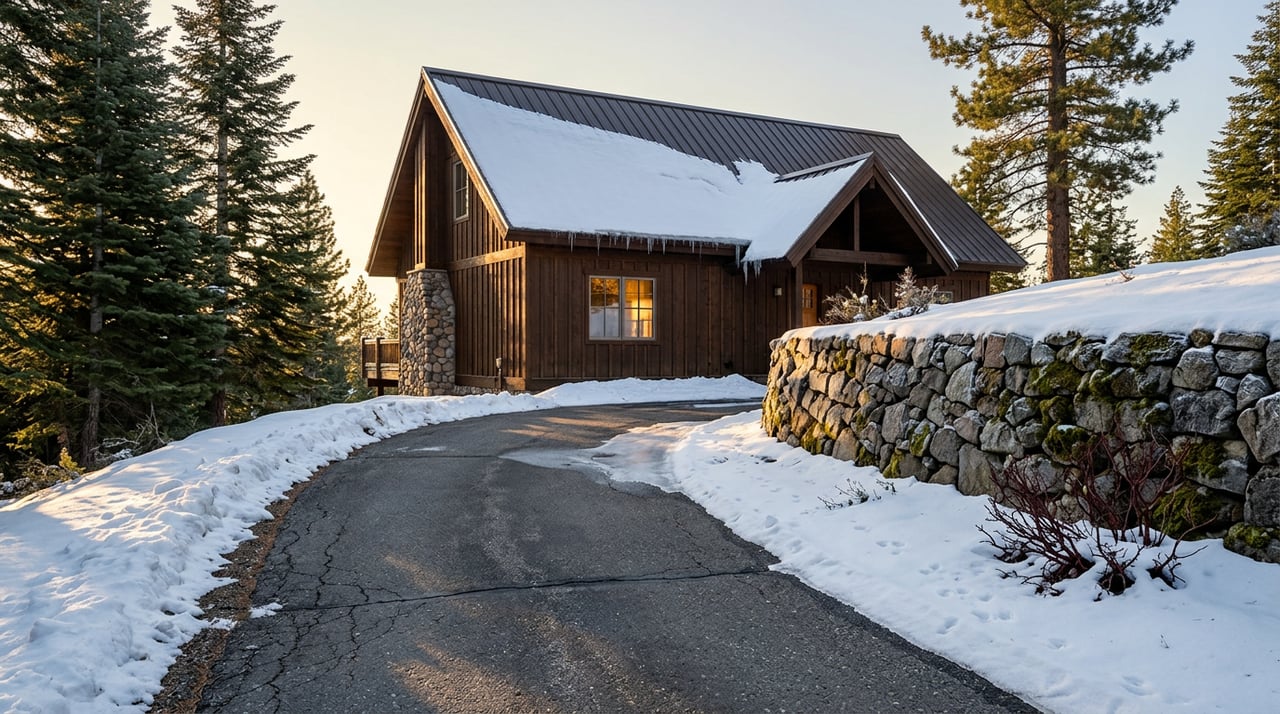
Who's coming to clear your street the morning after the first real snowfall?
It's not a question most buyers think to ask, and it's not one that shows up as a line item anywhere in the listing photos. But in Running Springs, the answer changes street by street, sometimes house by house, and it has almost nothing to do with what the home costs. A $700,000 custom build and a $375,000 cabin two streets over can sit under completely different plowing arrangements, and the more expensive one isn't automatically the one that gets cleared first.
In July 2026, homes in Running Springs sold for a median price of $372,450, spending an average of 111 days on the market before closing. That's the number most buyers see first. It tells you nothing about who shows up with a blade on your street in January.
Three Systems, One Town
San Bernardino County's Public Works department maintains a public list of the mountain's road districts, and Running Springs sits inside a patchwork of at least three distinct arrangements, not one uniform system:
- County-maintained roads, funded through the county's general road budget and gas tax revenue. These are the streets MLS remarks specifically call out as "paved and county maintained," because agents and sellers know it's a selling point buyers actually look for.
- County Service Area road districts, small special tax zones that residents themselves voted to create decades ago, each covering a specific short stretch of road and funded by a defined annual parcel assessment that shows up on the property tax bill, not as an HOA fee.
- Private, HOA-governed communities, where a monthly due covers snowplowing directly through a contracted vendor, along with other shared costs.
None of these three regimes announces itself clearly on a listing sheet. The standard "HOA: Yes/No" checkbox on most search portals answers a much narrower question than buyers assume. A property can show "No HOA" and still carry a mandatory special tax for road maintenance, because a County Service Area isn't a homeowners association. It's a government special district, and it's collected the same way as any other item on your county tax bill.
What Twenty-Five Parcels Buy You
The clearest example is CSA 70 R-16, officially named Running Springs (School House Road) in the county's own records. It was established by an act of the San Bernardino County Board of Supervisors on May 14, 1984, specifically to maintain 0.94 miles of paved road. It funds that maintenance, plowing included, through a $600 per parcel, per year special tax spread across exactly 25 parcels.
Sit with that math for a second. Twenty-five households are splitting the cost of keeping under a mile of pavement open in a snow season. There's no advisory commission overseeing it and no board meeting unless residents call one. It's a small, self-contained system sized to a specific road, which means the service is narrow but predictable. If you own on School House Road, you know exactly what you're paying and exactly what it buys.
Compare that to a property on a general county-maintained street nearby. There's no separate line item, no dedicated crew assigned only to that block, and no guarantee of priority sequencing during a storm. Your road competes with every other county-maintained mile across the whole San Bernardino Mountains for the same fleet of plows. Some winters that's an afterthought. In a heavy storm cycle, it can mean waiting.
The uncomfortable truth here is that neither system is inherently better. A tiny, well-funded district covering less than a mile can get cleared faster than a busy county arterial simply because there's less road to cover per dollar collected. Price and reliability are not the same axis, and nothing in a standard listing sheet tells you which axis you're buying into.
The Other Model: Paying by the Month Instead of the Parcel
Then there's the leased-land HOA model, and Smiley Park Country Club is the clearest working example currently active in Running Springs. Homes here sit on land under a 99-year lease that renews automatically at transfer of ownership, and the HOA fee, listed at $208 per month in current 2026 listings, covers snowplowing and road maintenance directly, along with liability insurance and access to a clubhouse and pool. The breakdown on at least one recent listing split that fee into $132.73 for operating assessments and $75.27 held in reserve, with the association capping annual increases at no more than 10 percent.
That's a fundamentally different arrangement than either a county road or a CSA parcel tax. You're not waiting on a county fleet stretched across the whole mountain, and you're not splitting a fixed assessment with 24 neighbors on a single short road. You're paying a private association, monthly, for a defined service level, and that association is building reserves specifically so it can keep affording that service as costs rise.
The tradeoff is the land lease itself. A 99-year renewing lease isn't fee-simple ownership, and Smiley Park's rules, including a prohibition on manufactured homes, come with the territory. For some buyers that structure is a non-issue. For others comparing it against a fee-simple cabin on a CSA-taxed road, it's a real difference worth pricing into the decision, not an afterthought discovered at escrow.
Why This Matters More If You Won't Be There When It Snows
For a family buying a weekend cabin, an unplowed street for a day is an inconvenience. For an absentee owner or a vacation rental investor, it's an operational problem with a dollar figure attached. A guest who books a stay in January and can't get a car up the driveway is a cancellation, a refund, and possibly a review that costs future bookings. If you're not on the mountain to call around and find a private contractor when the county truck hasn't reached your block yet, the difference between a dedicated CSA-funded road and a general county street stops being trivia and starts being risk management.
This same three-way split exists elsewhere across the resort corridor. The county's road district list includes similarly small, resident-funded zones in Cedar Glen, Twin Peaks, and Lake Arrowhead, each sized to its own stretch of pavement. Running Springs isn't unusual in having this structure. It's just one of the clearest places to see it, because the contrast between a $600-a-year district, a $208-a-month HOA, and a plain county street all sit within the same small town.
Before You Write the Offer
The fix here isn't complicated, but it does take a step most buyers skip. San Bernardino County publishes an address-based snow removal lookup through its public works snow information site, letting you check directly whether a specific street falls under county maintenance before you assume anything from the listing description. Pair that with a direct question to the listing agent or seller: is there a special assessment tied to this parcel, and if so, what does it fund? For anyone seriously considering a specific address in Running Springs, that's a five-minute check that tells you more about your first winter there than the square footage ever will.
If you're weighing a specific street or comparing a leased-land community against a fee-simple option, that's exactly the kind of local detail our team at SoCal Resorts checks before a client ever writes an offer. We know which roads carry a CSA assessment, which HOAs are actively funding their reserves, and which streets have a track record of getting cleared fast versus late. Reach out and we'll walk through the specific parcel with you before winter makes the decision for you.